
Garage Door Repair: Repair or Replace? How Wilmington Homeowners Decide
Most homeowners have heard the 50% rule: replace the door if a repair costs more than half the price of a new one. It sounds tidy. It’s also a shortcut that ignores the actual deciding factor. Whether a Wilmington garage door is worth repairing comes down to the mechanical system underneath it – the springs, tracks, cables and opener – and whether that system has another five to ten years left in it. A door can look worn and still be a sound investment to fix. Another can look fine and be quietly on its last leg. We wrote this to help you tell the difference.
If reading through this makes you want a trained eye on it instead, call (877) 780-7403. Estimates are free, and we’ll tell you honestly which side of the line your door is on.
Why door age alone is a weak signal
Age tells you very little on its own. Two Wilmington doors installed the same year can be in completely different shape depending on how often they run, whether the springs were ever replaced, and whether the tracks have stayed aligned. A door that cycles four times a day wears very differently from one that opens once in the morning and closes once at night. What matters is the condition of each component, not the calendar.
That’s why we assess a door part by part instead of leaning on a single age cutoff. Here’s the rough lifespan picture we work from:
- Torsion springs: typically 7 to 12 years depending on cycle count. The most common failure point, and the most dangerous to touch.
- Extension springs: often shorter, and they need safety containment as part of a sound setup.
- Cables: several years, but they stretch and fray under load and should be inspected whenever springs are replaced.
- Tracks: can last decades if the door stays balanced; bend or misalign after an impact.
- Opener: 10 to 15 years for most units before the motor, logic board or gears give out.
- Panels: the longest-lived part, but also the most vulnerable to dents and impact damage.
When several of these parts are mid-life at once, the repair-or-replace math changes. One worn spring is a straightforward fix. Springs, cables and an aging opener all failing in the same year is a system that’s telling you something.
Assessing the mechanical system, not the surface
Here’s the framework we use, and the one we’d suggest you apply when weighing up a quote. Work through each component and ask two questions: how much life does it have left, and how much does it cost to renew compared with the whole system?
- Springs. If the springs are the only failing part and the door is otherwise balanced and quiet, repair is almost always right, even on an older door. Springs are a wear item. Replacing them resets a big chunk of the door’s working life.
- Cables and drums. These should be renewed alongside springs when they show wear. Skipping them to save a little on the job is a false economy.
- Tracks. Straight, secure tracks that the door runs smoothly on don’t need replacing. Bent or loose tracks after an impact may point to frame stress – see the next section.
- Opener. A tired opener on a mechanically sound door is a simple replacement. A new opener bolted onto a door with failing springs and stressed tracks is money spent on the wrong end of the problem.
- Panels. Cosmetic dents on a door with a healthy mechanism are just that – cosmetic. Structural damage to the frame is a different story.
Read together, these parts tell you whether the door has a decade in it or a season. That’s a far better guide than dividing the repair quote by the new-door price.
When cosmetic damage is really structural
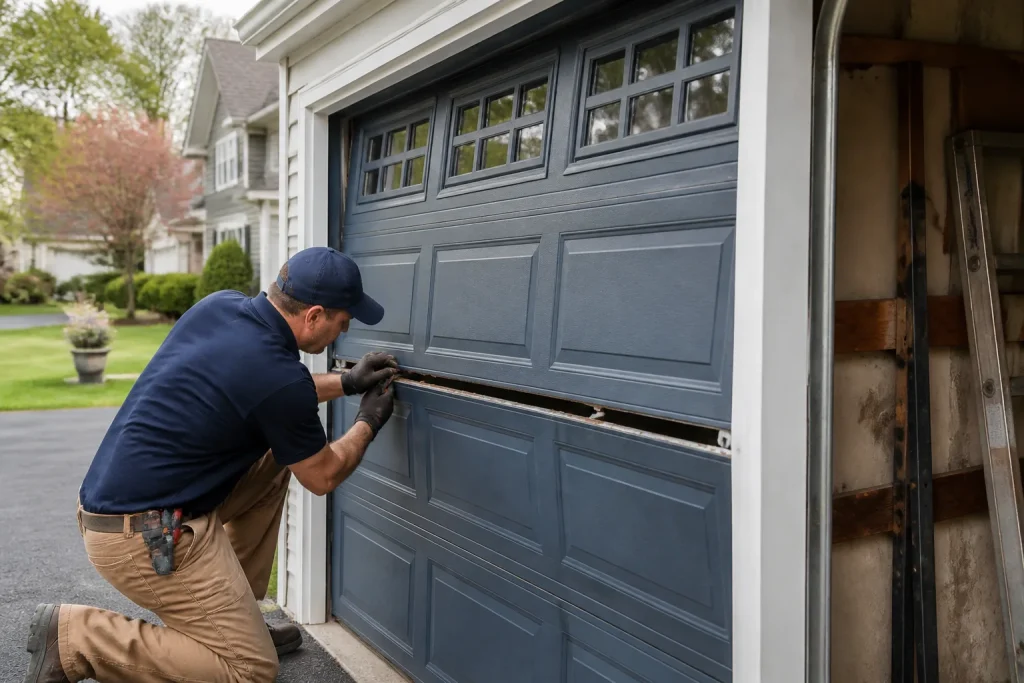
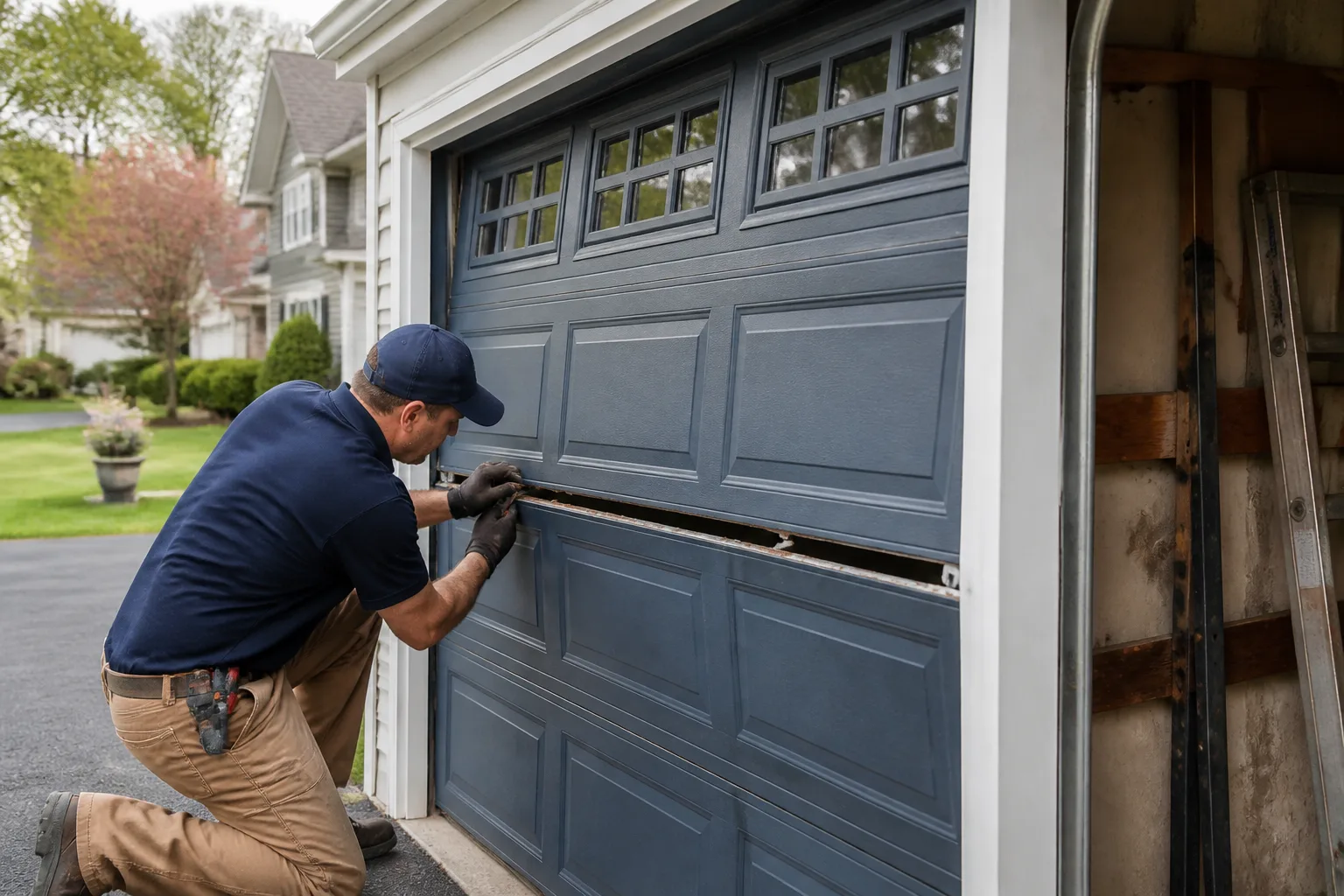
Dented panels are the most misunderstood part of the repair-or-replace call. A single panel dented by a stray basketball or a bumped car is usually cosmetic. If the door still runs level and quiet, you can live with it, or replace the panel if matching one is available for your model – brands like Clopay and Amarr keep panel profiles reasonably consistent, which helps.
What changes the calculus is damage that pushes beyond the panel:
- A dent that follows a visible crease or bend into the door’s frame or stiles.
- Tracks that have shifted out of plumb since the impact, so the door binds in one spot.
- A door that hangs unevenly or one side that’s visibly higher, suggesting a bent section or stressed hardware.
- Repeated panel damage in the same area, which usually means the door isn’t running true.
Any of these means the panel is the least of the problem. A door with stressed framing and misaligned tracks isn’t a cosmetic repair, and it isn’t a good candidate for a fresh set of springs either. That’s the point where replacement starts to make mechanical sense, not just visual sense.
When repair is clearly right, and when it’s throwing money away
We’d rather steer you toward the honest answer here than the bigger invoice, because a bad repair call comes back to bite both of us. Repair is usually the right call in these situations, even on a door that’s been up a while:
- The springs have failed but the tracks, cables and opener are sound.
- The opener has failed on an otherwise healthy, well-balanced door.
- A single panel is damaged and the mechanism is running true.
- The door is noisy, stiff or slow, but responds to adjustment and lubrication.
Replacing only the opener or only the springs becomes a waste when the rest of the system is already compromised. If the tracks are bent and the frame is stressed, a new opener just drives a struggling door harder, and fresh springs on a warped frame put load on hardware that can’t take it. In those cases you’re paying twice – once now, and again when the underlying problem forces a full replacement anyway. A component-by-component look, which is what our garage door repair assessment covers, is how we sort one from the other.
How Wilmington’s climate affects the longevity question
Wilmington’s freeze-thaw cycles and humid summers are hard on garage door hardware, and they should factor into any projection of how long a repair will hold. In winter, moisture works into small gaps and seams, freezes, and expands. That cycling loosens fasteners, works hinges and rollers, and stresses the metal where parts meet. Over a few seasons it’s one reason a door that was quiet in autumn develops a rattle by spring.
Summer humidity does its own work. It encourages rust on springs, cables and track rollers, and it can swell wooden door frames enough to throw a door slightly out of alignment. A door that binds in humid weather and frees up in dry weather is telling you the frame or track is moving. When we project how many years a repair will buy you in Wilmington, those seasonal swings are part of the calculation – a repair that would last a decade in a milder climate may need more attention here. Damp, fluctuating conditions also make it worth inspecting springs and cables more often than the calendar alone might suggest.
What a full replacement costs in Wilmington
To compare a repair quote against replacement, you need a real anchor number. In Wilmington, a full replacement for a common single-car door typically runs from around $900 to $1,800 installed, depending on style and material. A double-car door generally lands somewhere in the $1,600 to $3,200 range. Insulated steel and basic carriage-house styles sit toward the lower and middle ends; premium wood or custom looks push higher. Add the opener if it’s being replaced at the same time.
These are typical ranges, not a fixed quote. The written estimate sets the final price, and it’s quoted and agreed before any work starts. For comparison, spring replacement on its own is a small fraction of a new door, while a full system rebuild – springs, cables, tracks, opener – closes much of the gap. When you have both numbers side by side, the decision usually makes itself. If you’re weighing replacement, this is the point to book a free measure and a written price rather than guess.
When to call a pro
Springs and cables are under serious tension, and a snapped spring or a cable that lets go can cause real injury. We don’t recommend adjusting, removing or replacing them yourself, and no honest guide should walk you through it. Call a trained technician for anything involving the spring system, the cables, or a door that’s come off its tracks. If your door is stuck open and your garage is exposed, or stuck shut when you need to get out, that’s an emergency in practical terms, and we treat it that way.
Related services in Wilmington: if the door runs but the motor won’t lift it, that’s garage door opener repair territory. If you hear a loud bang and the door won’t open, it’s almost always the springs – garage door spring repair is the fix. Our technicians have up to 8 years of experience, and we work on LiftMaster, Chamberlain, Genie, Clopay, Amarr, Wayne Dalton, Craftsman and Raynor, so there’s no brand we’ll turn away. One call covers springs, openers, panels and full replacements.
The Bottom Line
The real question isn’t how old the door is or whether the repair costs a certain percentage of a new one. It’s whether the mechanical system underneath – springs, tracks, cables and opener – has another five to ten years in it. If the failing part is a wear item and the rest of the system is sound, repair wins, even on an older door. If multiple components are mid-life and the frame or tracks are stressed, replacement is the honest answer. Wilmington’s freeze-thaw and humidity make that a year-by-year judgment, not a one-time one.
If you’re in Wilmington and want a straight read on your door, Wilmington Garage Door Repair Co offers free estimates. Call (877) 780-7403 and we’ll give you a component-by-component answer, a written price, and no pressure to replace what can be fixed. Our technicians have up to 8 years of experience, and garage doors are all we do.
Frequently Asked Questions
Repair is usually worth it when the failing part is a wear item – springs, cables or an opener – and the tracks and frame underneath are still sound. Replacement makes more sense when several components are wearing out at once or the frame and tracks are visibly stressed. The condition of the mechanism, not the age of the door, is the deciding factor. For a real number on your door, call (877) 780-7403 – estimates are free.
It depends entirely on what’s failed. Spring replacement, opener repair and panel fixes sit at very different price points, which is why we quote per job after seeing the door rather than guessing over the phone. The full picture matters, since replacing only the springs on a door with bent tracks wastes the money. Call (877) 780-7403 for a free estimate and a written price before any work starts.
No – the written estimate sets the price, and we quote and agree it with you before any work begins. The point of the in-person look is to confirm exactly which components need attention so the number is accurate the first time. If something unexpected turns up once we’re in, we stop and talk it through with you, not bill you after the fact.
Yes, if the door’s springs, cables and tracks are in good shape – a new opener on a mechanically sound door is a sensible, economical repair. But if the mechanism underneath is compromised, a new opener only drives a struggling door harder and you’ll be paying again soon. Can you come today? For a run-out or jammed door we offer same-day and emergency service, and it’s worth a call to get a trained eye on it first. Call (877) 780-7403. We answer 24/7. A call outside dispatch hours is booked into the next opening, Sunday through Friday, 7am to 7pm.
Written by the team at Wilmington Garage Door Repair Co.
Need Garage Door Help?
Call Wilmington Garage Door Repair Co - the local pro we connect you with is licensed and insured, here with fast help in Wilmington.
(877) 780-7403